
There are occasions in the daily grind of our existence, when we’re all mostly preoccupied by our scheduled tasks and deadlines, that an event of historic proportions breaks through our collective self-absorption and screams at us to pay attention to our life together as a nation.
9/11 was one of those times. January 6 was, too. And, sadly, the attempted murder of former president Trump joins those historic shocks to our joint American consciousness.
Very thankfully, Mr. Trump was not seriously injured from a physical standpoint, though perhaps he will, like most gunshot victims, experience lingering emotional and psychological wounds from the traumas of this day. I hope he experiences deep healing on all fronts.
This is also a traumatic moment for our nation. In a way, the fact that we are shocked by news of this attempted assassination is a good sign; we Americans mostly reject violence as a means of settling political and civic disagreements. It’s extremely abnormal to us; it feels extraordinarily wrong. Most governments throughout human history, and many current political systems around the world, do the opposite.
And so at this critical point in the American story, we must, regardless of our political, religious, racial, ethnic, sexual, gender, generational, and economic identities and our levels of health and ability, recommit ourselves to the ideals expressed in our national creed.
Wait, what? We have a national creed?
I’m not talking about our Constitution or even the Declaration of Independence, nor am I alluding to the “In God We Trust” on our coinage. I’m referring to the Pledge of Allegiance, which is the closest thing we Americans have to a national creed – something that those of us who grew up in the U.S. basically have memorized, that most of us could repeat word-for-word at the drop of a hat, and that contains the core ideas of what it means to be an American.
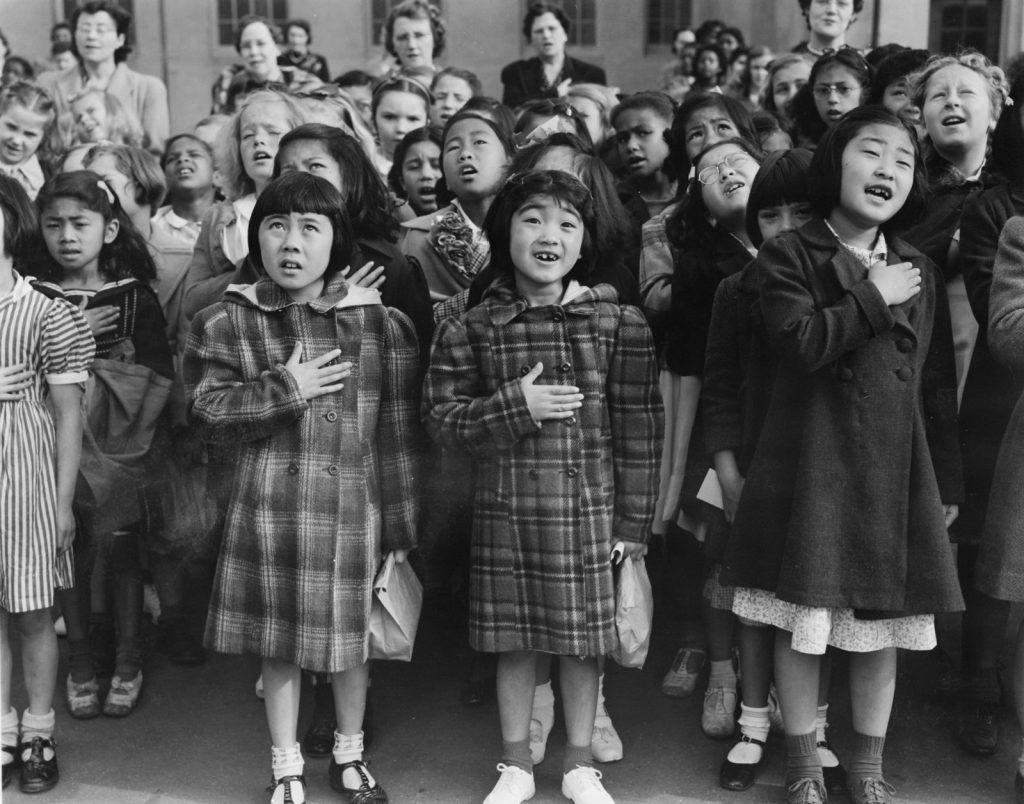
I mean, in our schools, students and teachers recite it, often every day. And when they do, it’s beautiful. People of every background and belief and heritage are declaring it together. There’s really nothing else we Americans affirm out loud with such regularity.
(Some folks would say that our musical National Anthem could also be a national creed. But though it’s ubiquitous at American sporting events, its frequency of usage still pales in comparison to the millions of kids and adults who say the Pledge out loud on a daily basis in our schools. Plus, I would add that the only National Anthem verse that we ever sing doesn’t say what our core American ideals are; in fact, it’s not a statement but a question of whether we can see something, you know, by the dawn’s early light.)
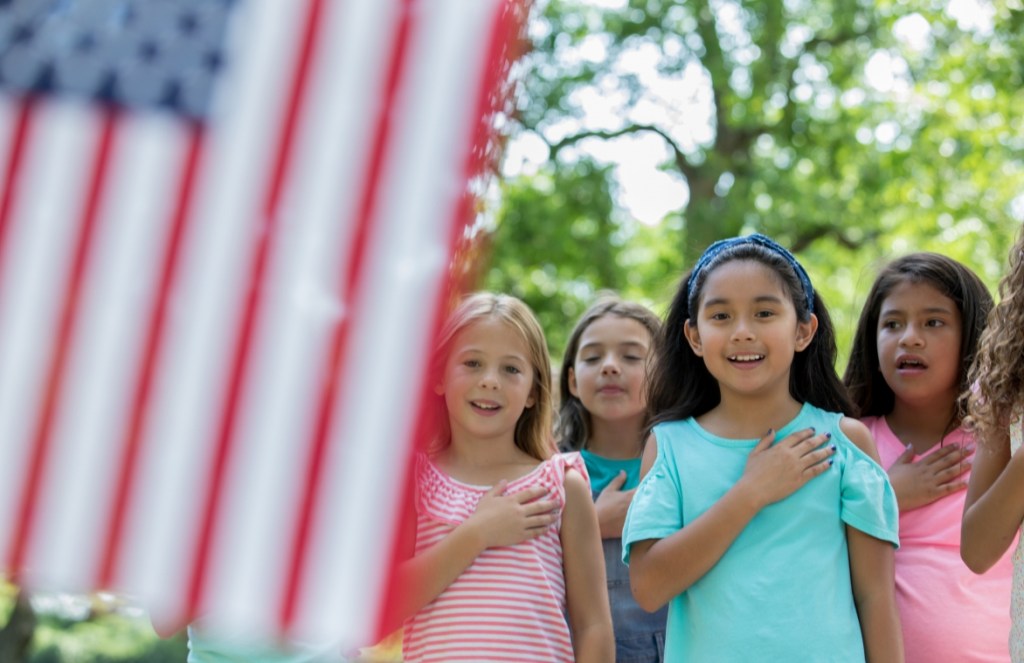
Just by way of reminder, the words to the Pledge go like this:
I pledge allegiance to the Flag of the United States of America, and to the Republic for which it stands – one Nation under God, indivisible, with liberty and justice for all.
While growing up, I heard teachers sometimes call it the Pledge to the American Flag, or just the Pledge to the Flag. But that’s not even the heart of the Pledge, because the American flag is merely a textile symbol. The Pledge is a promise that I am making to the Republic for which the flag stands.
Republic is a term that’s often used to refer to a representative system of democratic government. But it derives from the Latin word publicus, meaning “the people.” What are we making a pledge to? The people.
That means us. You and me and everyone else here that’s part of this crazy, 336 million-plus motley crew.
I explain to my students that the Pledge is most definitely not just a pledge to a flag. It’s a promise that I make to them, that they make to me, and that we all make to each other and to everyone else in this land. We’re promising that we will pursue, with all our might, the indivisibility of our people, always valuing each other, working with each other, and never giving up on each other, regardless of our differences. “We’re all in this together,” as it were, so we don’t scapegoat each other or secede, and we never resort to violence or make excuses for those who do. We’re also promising to seek freedom for every single one of us – that as much as possible, we will enable everyone to be the best they can be in the ways they want to be; we will also work for justice for one another, fighting the intimidation, bullying, and oppression suffered by any at the hands of someone more powerful.
Credible threats and acts of political violence have grown exponentially in recent years, most embodied by former president Trump’s own violent efforts to hang onto power by calling together and sending a mob of supporters to attack the Congress of the United States and his very own Vice President, actions that resulted in deaths and numerous injuries to Capitol Police. Objectively, no other president in recent history has publicly used as much threatening and abusive language against people he didn’t like and shown so much hesitation to condemn violent groups that support him. Accountability for turning down the heat on our national rhetoric must include Mr. Trump; for his allies to pretend that he hasn’t played a huge part in fueling political violence is not only deceptive, it’s gaslighting. For those allies to rightly call out President Biden’s metaphorical use of the phrase “bull’s eye,” yet also act like they haven’t excused on many occasions Mr. Trump’s much more egregious behavior, is hypocritical. Calls for unity must always be based on truth and facts, on confession of one’s own wrongs and a commitment to do better. Yet absolutely none of Mr. Trump’s actions or words justify one bit of violence against him or his supporters. At this moment of crisis, when the attack on the former president edges us toward a deepening cycle of violence, all of us Americans can fight that momentum toward darkness.
We can start by coming together and recovering our national creed, recommitting ourselves to the values of a pledge that we may have repeated mindlessly as kids, yet which holds the power of a promise we make to each other.
One Trump supporter in Milwaukee, interviewed by NBC News ahead of the Republican National Convention, said, “Love the ones who vote differently than you.”
That’s the spirit of the Pledge of Allegiance to both our flag and to our people.
 Feminist Asian Dad